Showing posts with label Supermarket Surivival Guide. Show all posts

How Manufacturers Make a Label Sound Better Than it Acually is


I've talked here before about marketing claims you should watch for on packages, but did you know that there's ingredients you should watch for too? I've always said that the ingredient list never lies, but unfortunately, because more and more consumers are reading the ingredient list,more and more companies are learning to 'spin' it. They are legally required to list all ingredients, but they sometimes make ingredients sound nicer than they really are or they play with the order of things to make the product sound healthier.  Here are a few examples to watch out for (after the jump)

Supermarket Suspects: "Healthy" Foods that Don't Deliver


So we've talked about granola, crackers and juice as being less healthy than they're touted to be. But are there any more suspects lurking on the supermarket shelves? Of course there are! My top contenders (plus healthier switch-outs) below:


5 Marketing Claims You Shouldn't Fall For


I've said it before - never believe anything you read on the box, even if it sounds healthy. Especially if it sounds healthy. Here are five phrases you should be wary of:

Made with the goodness of wheat
This is a popular one, often found on packages of crackers, bread and pastas. Notice it doesn't say what kind of wheat. That's because it's likely refined. So basically, this says, 'Made with white flour.' Like 90% of processed food products out there. Thanks for the heads up.

Made with whole wheat/whole grains
You may think this one is better - after all, it says whole wheat or whole grains. But it doesn't say how much. So odds are, the first ingredient is still white flour. The manufacturer has likely just put in enough whole wheat/whole grains to colour the white flour brown and make you think you're eating something heathy. Again, ignore.

Made with real fruits/vegetables
Again - nothing here about how much actual fruit/vegetable is in the product. Often it's minimal (you can tell by how low the fruit/veggie is on the ingredient list.) And usually, there are enough other artificial ingredients to negate the goodness of the veggie in the first place. 

Reduced fat
This is a tricky one. Less fat is good, right? The answer is, it depends. All things being equal, yes, less fat is good. But remember: fat delivers flavour. If the manufacturers remove fat from a product, they still have to make it taste good - so they may add sugar or salt in to replace the lost flavour, and other chemicals to mimic the role of the fat. The best thing to do is to compare the original and reduced-fat versions and choose the one with the simplest ingredient list. 

Source of energy
This one kills me. Energy is measured in calories. All food is made up of calories. So absolutely all food is a source of energy. This is a claim food companies use when they really do not have anything healthy to tout about the product at all. In fact, it's usually a sign of an unhealthy product - Nutella uses this in their advertising campaigns. (Sure, it gives your kids energy - in the form of a sugar high. They neglect to tell you that little Joey will be crashing by math class.)

Are there any marketing claims you're not sure about? Let me know in the comments and I'll do my best to debunk them!


For more tips on how to read labels, see my post on Grocery Shopping Shortcuts or see whole list of posts on Navigating the Supermarket.
...and have you had your grocery list pimped yet? 

photo credit: partymonstrrrr via photopin cc

Supermarket Surivival Guide: Cereal Aisle


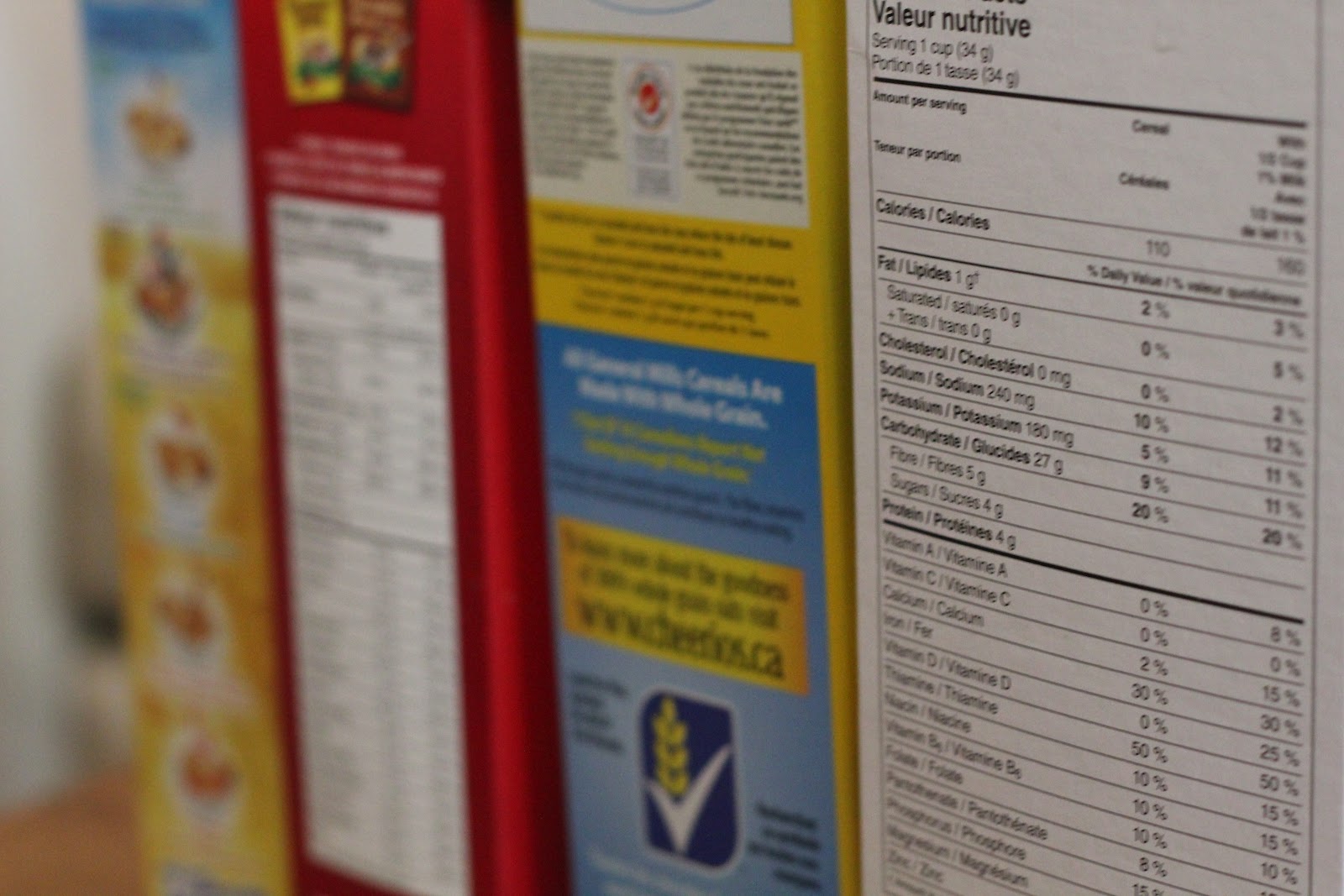
One of the trickiest aisles to navigate in the supermarket is the cereal aisle. This is because, like yogurt, cereal has a "health halo", which is food industry-speak for the aura of health that sounds a particular food (whether it deserves it or not.) People often think it's a lot healthier than it is. 

Another reason it's tricky is because it's full of spit and polish - beautiful, inviting colours, pretty fonts, photos of luscious berries tumbling into those wholesome flakes. But when you turn the box around, what you see is that most cereals are made up of wheat, rice, corn and sugar, followed by a long list of non-pronounceable ingredients.


So how do you navigate this minefield of good and not-so-good choices?


Here are some guidelines::


Look for cereals with 4 grams (1 teaspoon) of sugar or less

I know:  you know enough to stay away from sugary cereals. Let me just say this - it is not just the blatant Choco-Caramel Rings and the Cupcake Crispies that you need to watch out for. Many of the more wholesome sounding cereals aren't exactly good choices either, as this video from the Yale Rudd Center for Food Policy and Obesity points out. To stay on the safe side, look for cereals with 4 grams (1 teaspoon) of sugar or less per serving.


Look for cereals with at least 3-5 grams of fibre

The Dietitians of Canada recommend 25 - 38 grams of fibre per day to help lower cholesterol, manage blood sugar levels and help keep you regular. I know - that is a WHACK of fibre and most of us don't even get half of that. Breakfast is an easy way to get some. (Note - if you don't like high fibre cereal, sprinkle 1-2 teaspoons of bran, chia seeds or flax seeds on your regular cereal. It's a great way to sneak in fibre)


Ignore the 'low fat' claim

So many cereals carry the claims 'low fat', 'fat free' or 'saturated fat free' these days. That's a good thing, right? After all, you want to fit into that red dress!

Guess what? Almost every plain cereal is low in fat. That's because it's made up mostly of flour or rice or corn, which are low in fat. So choosing a cereal because it is low in fat is like choosing a cheese because it is made with milk. Companies only market it that way because they know that will make people buy it. 

Will it help you lose weight? Well, if you eat the serving specified and it fills you up and keeps you going until lunch, then it might. The problem is that most cereals are highly processed and made from white flour or white rice or corn, which means they don't actually fill you up.  You are basically having a bowl of white rice with some sugar on it. And because it doesn't fill you up, you end up having a second (or in my case third) bowl, or you give in to that muffin at 10 am. So much for the red dress.

Better, I say, to have some fat - good fat, of course, which will keep you full and going until lunch. Put some nuts on that high-fibre, low sugar cereal and enjoy. 


And as always, follow the three simple rules: never believe the front of the box, the ingredient label never lies, and read the nutritional panel. 


I know, I know: high fibre, low sugar cereal doesn't exactly scream hedonism. I hear you. In fact, I love cereal - anything that is carb-laden practically has my name tatooed on it. So I indulge occasionally. But I see those overly sweet, 'diet' cereals that I love for what they really are: dessert, not breakfast. Eating a bowl of sweetened, flaky cereal to get me going in the morning may not work, but having a bowl instead of the butter-rich cookies I was going to have for dessert is a good trade off to me.


You can read my other Supermarket Survival Guide here:
Supermarket Survival Guide: Yogurt

Find the best and worst choices in the supermarket here:
Top 5 Hidden Gems in the Supermarket
Healthy Pretenders: the Most Overrated foods in the Supermarket

Read my other articles on navigating the supermarket here.

How to Avoid Big Food Marketing Pitfalls: Grocery Shopping Shortcuts

After my last post discussing the reality of food marketing, reader The Job Hunter asked a great question about whether there were any short cuts to analyzing products in the grocery store (especially once you are exhausted from a long day at work.)

Hey, I hear you. I have a crazy one year old will sit still for exactly 11 seconds (yes, we've counted.) And I used to grocery shop after work too, so I know that the decrease in mental capacity is exactly proportional to the increase in cravings after 5 o'clock.

Over the years, I've come up with a  series of shortcuts to help cut down on the analyzing and scanning time at the grocery store and still make the best choices at the shelf. Here are my top guidelines:

1) Always choose the less flavoured option.
If there is one thing I can guarantee, it's that the more ingredients a product has, the higher the probability that many of those ingredients are crap. This is especially true with flavoured products; for example, pomegranate-blueberry yogourt likely has very little pomegranate or blueberry in it (it's probably mostly juice and artificial flavours.) Ditto for the Choco Banana O's - likely full of fake chocolate and banana flavouring. By choosing plain yogurt or plain cereal, you avoid most of these 'fake' ingredients. I know they sound way more boring than the exciting flavours, but you can make them exciting at home with a lot less chemicals. 

2) Ignore any claims that require a question.
Sometimes, when a company can't make a specific claim about a product, they will dial it back to a much softer claim that makes the consumer think it is good, but doesn't actually say anything.  For example, instead of making a '100% Whole Wheat' claim, they may say 'Made with the Goodness of Whole Wheat.' This sounds just as good, but really doesn't mean anything at all. How much whole wheat is in it?  Odds are the first ingredient is likely white flour.

You can spot these claims because they are usually ambiguous, unmeasurable, and lead to another question. For example, if it says 'Made with whole grain', it would lead you to ask, 'how much whole grain?' Probably not a lot, if they don't specify on the box. (In fact, most 'Made with' claims are in this same category.)

And same for 'Multigrain.' What kind of grain? How much of it is used? If they don't specify, then think of multigrain as a flavour, not a health benefit. 

This approach requires a bit of critical thinking at first, but remember: most claims are basically the same. So once you do it a couple of times, it will be easy to weed out the fake claims from the real ones. 

3) Be wary of the flashy aisles.
When my husband and I were house hunting in a trendy up-and-coming area just outside of downtown, we were always suspicious of the beautifully renovated houses, the ones with the new hardwood floors and the fancy backsplashes. With a broken down, sagging old house, at least you know what you are getting. But put a little bit of spit and polish on it and you never know what's lurking inside.

This is exactly the same way I feel about supermarket aisles. The 'unsexy' sections - beans, bulk nuts, grains, canned goods - are usually pretty ho-hum. There's not a lot of flash there, and you generally know what you're getting. But once you go into those inviting aisles with the cheery colours, the beautiful food photography and the cursive fonts, it's all spit and polish again. So if you can't look at the back of every product, then make sure you look at the ones in the 'flashy' aisles (for example, cereal, granola bars/snacks, yogurt.) A good way to tell if an aisle is flashy is to remember if you've seen a TV commercial for it lately - if companies are investing in TV ads, you can bet they're investing a lot of dollars to appeal to consumers.

4) Shop the perimeter.
One of the best ways to cut down on label-reading time and still make simple choices is to buy most of your groceries from the perimeter of the grocery store. this is where the fresh food is kept - produce, dairy, eggs, etc. Now, you won't avoid all the flashy aisles (yogurt has become a big one), but you will cut down on them considerably. 

These guidelines help me stay on track at the grocery store and still get out in a reasonable amount of time. What about you? Are there any tips and tricks you have learned to simplify your grocery shopping and still make the best choices?


Confessions of a Processed Food Marketer; or What You Need to Know Before You Set Foot in a Grocery Store Again

Have you gotten your grocery list pimped yet? That' right, send me your grocery list, and I'll give it a free healthy makeover! Details are here!

I’ve worked in the processed food industry for several years, up until I had my son last year. Although I liked the challenging environment and the people I worked with, I was never comfortable with the actual marketing of processed food. And the more I learned about how food is made and marketed to consumers, the more uncomfortable I became.

I had never really thought about food companies before I worked for one. I just assumed, like most people, that the products they produced weren’t really that bad. After all, if they were, they wouldn’t be allowed to put them on the supermarket shelf, would they?

What I realize now is that goal of food companies is not to make good food. Food companies are neither good guys nor bad guys. Their goal, like every other company, is to make consistent and growing returns for their shareholders.

The grocery market in North America is well developed; there’s not a lot of growth happening. Input costs are rising, and competition is fierce. So how does a food company make money in this environment? Well, they do whatever it takes to attract you to their product, even if that involves a certain amount of misrepresentation. 

Just look at the packages all around you to see how true this is. Crackers that say they are ‘made with real vegetables’ are usually little more than oil, white flour and salt, with a little dehydrated vegetable thrown in for colour. ‘Multigrain’ bread is usually white bread with a few grains added to make it look healthier. ‘Chocolatey’ flavoured bars often have no actual chocolate in them; honey nut cereal usually has very little honey or nuts.

I’m not trying to be a food vigilante here. I don’t think you should grow all your own corn or join a CSA or purge all forms of sugar from your cupboard. I recognize that most of us don’t have the time or the mental resources to devote to living this way (not to mention that a life without sugar would be a very sad one!)

But I do think that the responsibility falls on us to be educated about what we’re buying. The food companies are not going to do it for us; in fact they are going to do everything they can to make it as difficult as possible. It’s up to us to wade through all the claims and the marketing jargon and the fancy packages to make the best choices for us.

I know that sounds daunting. Who wants to go to the grocery store as if they are crossing enemy lines?

But the truth is, it’s not that hard to navigate the grocery store battlefield if you stick to a few basic rules:

1) Never believe anything you see on the box. Everything on it – the claims, the colour of the box, the flavour name, the photography - is designed to persuade you. Ignore it.

2) The label never lies. Flip to the back of the package and read through the list of ingredients. Leave behind anything with ingredients you can’t pronounce, and if one of the top three ingredients is corn, white flour, sugar or soy, try to limit how much you buy.

3) Read the nutritional panel. First, look at the top to see how much a serving is (it might be a very small amount of the actual package, which makes all the nutritional information look rosy.) Then, glance at the key lines to make sure they look reasonable: Calories, sugar, fat, salt, fibre.

Then – and only then - make an informed decision of whether to put it in your cart. That’s right – I’m not saying that you automatically curse and spit on anything that isn’t of a stellar nutritional profile. But I do think you need to know what the product really is before you make the decision to buy it.

I think processed food serves a place in people’s lives. It is convenient. It is often portable. Sometimes, it’s the only way you can get dinner on the table or grab breakfast before you run out the door. But I do think we need to be aware of exactly what it is we’re eating, and make a conscious decision when we decide to eat it.

This is the beginning of a series of articles I will be writing about the processed food industry to expose some of the mistruths and help you make better decisions at shelf. Remember: companies will only make what we decide to buy, so the best way to change what they make is to vote with our dollars.

Healthy Pretenders: The Most Overrated Foods in the Supermarket

Instead of juice try an herbal tea refresher: half herbal tea, half club soda, a few blueberries and some basil leaves.

I admit it: sometimes I'll stand in front of the grocery store shelf for what seems like ages, picking up and putting down the same box of cereal, not sure if it's a healthy choice. The row upon row of brightly coloured boxes can seem so mystifying! But over the years I have learned a couple of things about making the best choices in the supermarket maze.

Just as there are some overlooked superheroes of the supermarket, there are those not-so-good choices lurking on the shelves, too. Now, I don’t believe that you should stay away completely from any one food (I am a hedonist, after all), but certain foods are disguised as healthy when they really should be thought of more as desserts or occasional snacks. See my list below for the top contenders.

Granola
What can be bad about oats, nuts and fruit? It’s about as basic as you can get! True, but those oats often have tons of added fat and sugar. And dried fruit and nuts are calorie-dense - which means that you are getting a lot of calories per bite. All this means that granola usually packs anywhere from 200 - 400 calories in a measly half cup (about the amount that fits into a small ramekin.)

Is it the worst food ever? Of course not. But those delicious granola parfaits you see on The Food Network with handfuls of homemade granola, nuts and maple syrup aren’t going to do your waistline any favours, no matter how wholesome they look.

It doesn’t mean you shouldn’t eat granola - I love it in the fall because it's such a perfect complement to the crisp weather.  But when choosing your granola, make sure to check out how many calories are in a serving (and how big that serving size is!) And don’t be fooled by cereals marked ‘Granola Crisp’ or ‘Granola Clusters’ and the like - though they may be lower in fat, they just mix the granola with refined carbs like corn or wheat flakes.

Your best bet is to find a granola that has oats as the first ingredient and doesn’t have too much sugar. To minimize the calorie punch, mix it with a puffed rice or flake cereal that is high in fibre. Now you can have your granola and eat it too!


Crackers
I love me a good cracker. In grad school I would often sit on the couch with a box of crackers and a wedge of cheese for ‘light’ dinner - except the dinner was usually far from light once I’d ingested a box full of crackers and half a block of cheese. Crackers are a fine occasional snack, but remember that they are mainly made up of white flour, oil and salt, so you are basically eating empty calories. It’s best to think of them as an alternative to chips as opposed to something healthy.

So how do you make the best choice? Make sure when you choose a cracker that you read the nutrition panel and the list of ingredients. Try to choose ones that have some fibre and very little salt, and stay far away from the ones that have some form of sugar and unrecognizable ingredients. (Remember - just because it says ‘whole grain’ or ‘made with vegetables’ on the package doesn’t mean it’s good for you - in fact, it’s probably not. Just choose the one with the simplest ingredients.)


Juice
Yes, juice. I know it’s made from fruit, but juice can pack a whopping calorie and sugar punch. Think about it: when you eat an apple, you are getting the sugar and calories of one apple, as well as the fibre from the peel and the pulp to help regulate the sugar as it's digested. When you drink a glass of apple juice, you are getting the sugar and calories of 3-4 apples, without any of the fibre or valuable nutrients from the pulp and the peel. Juice also elevates your blood sugar more quickly, leaving you tired and lethargic when it dips again.

Again, I'm not suggesting you stay away from juice entirely, though it is better to eat your fruits than drink them. But do make sure you read the label when you buy your juice. Most fruit juice is mostly apple or orange juice, no matter what exotic fruits they have on the box. So make sure the fruits on the box are the first ingredients in the juice you buy. Also, ignore pseudo-healthy sounding names and claims - they likely aren't adding much to the juice anyway. And of course, avoid ones with added sugars.

Finally, when you drink your juice, cut it with water or club soda so that you are getting half the sugar and calories. Or try mixing cold herbal tea with club soda and ice - it's a great summertime refresher!

Top 5 Hidden Gems at the Grocery Store


Pear - Pumpkin Spice Smoothie: using one of my favourite versatile ingredients.

I would sum up my cooking philosophy this way: minimal effort for maximum taste. I like my recipes to be simple, natural, tasty, and preferably made in one pot. So when I go to the grocery store, I am always on the lookout for ingredients that can help me in this endeavor. But I’ve learned to stay away from the quick convenience foods in the frozen and prepared foods section – they usually overpromise on convenience and underdeliver on taste. Instead, I head to the nether regions of the grocery store, where the humble warriors of dinner preside. While they don’t have the fancy claims or flashy packaging of the newest convenience products, they are often just as easy to use and much better for you. Here are 5 of my favourites:

1.   Black beans
Oh, the lowly black bean. It’s not going to win any popularity contests, being small, mild flavoured and kind of boring, really. But it’s the Clark Kent of beans – boring on the outside, but Superbean on the inside! It’s full of fibre and protein (15g of each per cup!), which means it will keep you full for a long time, reduce blood cholesterol, keep your blood sugar stable and your digestive system humming along. Not to mention, it’s chock full of the minerals magnesium, phosphorus and manganese, and the B vitamins.

 And because it’s tiny and mild flavoured, it can be added to almost anything. I buy the canned kind, rinse them, and then keep them in my fridge. I thrown them into salads and soups, mix them with brown rice and put a poached egg on top for a quick lunch, or just mash them with an avocado, some salt and a lime for a quick snack. Or I mash them into Baby M’s food for some protein. And on top of being nutritious and convenient, they are cheap! They should have some sort of superhero crest on the label.

2.   Canned Pumpkin
Canned pumpkin shouldn’t be the uncle you only see at Thanksgiving – it should drop in for tea on a weekly basis. Pumpkin is a crazy superfood – it provides more than 200% of your Vitamin A needs per cup, is a source of fibre, contains antioxidants and has more potassium than a banana. Buy pure canned pumpkin (make sure there is no sugar or additives) and you can use it for a quick nutrient boost at breakfast, snacktime or even dessert. Throw a little in your smoothie  (I love it with yogurt, pears and cinnamon.) Mix some into your oatmeal in the morning along with some pumpkin pie spice. You can even add it to brown rice and make your own Pumpkin Rice pudding. And the best part? No peeling or chopping needed!
I freeze portions in ice cube trays and just nuke what I need. Again – great instant baby food.

3.   Grainy mustard
My condiment of choice used to be ketchup. I’d pull up in front of the TV, plate of chicken fingers and fries in hand, and put the bottle of ketchup right beside me. Then I’d squeeze a nice, generous dollop of the stuff onto my plate, and refill it least three times.
Then I turned the bottle around and realized that the first ingredient was sugar, not tomatoes. Oops.
I still like ketchup with my chicken fingers occasionally, but I turn to grainy mustard for most other things. It’s much lower in calories and tastes delicious. It’s great with a turkey burger, in a vinaigrette, or on top of fish or chicken. It also tastes great in tuna salad (and as a bonus, it replaces the mayo!)

4.   Low fat ricotta cheese
When I was a kid, my mom’s diet food of choice was cottage cheese. We had countless tubs of it in our fridge, and let me tell you, it was revolting. Yes, it was high in protein and calcium, but it was salty and lumpy and clammy – definitely not up to my hedonistic standards. Then one day in the grocery store, I decided to take a chance on low-fat ricotta – and my life has never been the same. People, the stuff is delicious. It’s got a creamy texture and doesn’t have the tartness of yogurt, so it’s a great replacement for ice cream or whipped cream in desserts. And it’s just as high in protein and calcium, with lots more Vitamin A. Jackpot!
I often put it on top of roasted pears and drizzled with maple syrup. Or I take it as a mid-afternoon snack to the office, mixed with pink grapefruit and blueberries.  Or even mix it with tomato sauce to make a rosé sauce for my pasta.
Now, the only cottage cheese around me is on my thighs.

5.   Cocoa powder
I’m the kind of person who needs something sweet at the end of a meal, or I don’t feel satiated. While A. can have a couple of bites of pineapple or a clementine and be perfectly fine, my stomach is saying ‘TEA AND COOKIES TEA AND COOKIES TEA AND COOKIES’ in its most insistent voice. In my quest to find something sweet that wasn’t over the top for everyday, I stumbled on cocoa powder. Mixed with milk, a little sugar, some cinnamon and a dash of cayenne pepper, it makes the best hot chocolate around. Plus, it’s natural, which is hard to find in the hot-chocolate section (have you ever looked at the ingredients on packaged hot chocolate mixes? They are mostly sugar and oil, with very little chocolate.) It’s also great mixed in with yogurt or in baked goods. While I am a firm believer in indulging in dark chocolate, a nice cocoa powder saves me from going overboard sometimes.

Those are my top five. How about you? Are there any hidden gems that you go back to over and over again? Let me know in the comments!

Supermarket Survival Guide: Yogurt Aisle


The yogurt aisle is a minefield of good and bad choices. This is because yogurt has, in food industry-speak, a ‘health halo’ – meaning people perceive it to be healthy. Sometimes it is – and sometimes, not so much.

Don’t get me wrong – plain, low fat yogurt is one of the healthiest choices you can make. It is loaded with calcium, protein (especially greek yogurt) and good bacteria. But there are a lot of not-so-healthy options hidden in there too, with added sugar, sweeteners, and fillers. In fact, a lot of fruit-flavoured yogurts don’t have much fruit in them at all – just fruit juice, sugar and colours. As I walked through the yogurt aisle this afternoon, I was hard-pressed to find one flavoured yogurt that didn’t have some form of sugar, sweetener or corn product as the second or third ingredient. Plus, a lot of them have fillers and binders like carageenan, guar gum, agar and locust bean gum. Some of the yogurts targeted to kids are the worst offenders!

As leading food authority Marion Nestle puts it, “Most yogurts are dessert. Yogurt, it seems, has performed a marketing miracle; it is a fast-selling dairy dessert with the aura of a health food.”

I don’t take quite so negative a view. Sure, yogurt has a health halo that some versions may not deserve; but there are some good picks in there, too. The trick is to read the ingredient list carefully and not get confused by the seemingly endless options.


So what should you look for?


Low fat.

I know some of you hate the consistency of low fat yogurt. But the thicker texture of the new Greek yogurts makes it hard to tell the difference! Try one!

No added sugar (preferably plain yogourt)

As I mentioned above, a lot of yogurts are filled with sugars, sweeteners, fructose - sometimes as the second ingredient! It’s best to get plain yogurt and flavour it up yourself – that way you control the sweetness (and the chemicals!) Also note: don’t be fooled with words like ‘fruit preparation’ on the ingredient list – this is just marketing-speak to make it sound fancier. Often the first ingredient in this so-called fruit preparation is sugar.

Short list of ingredients.

All yogurt really should have in it is skim milk and bacterial culture. If you're looking for a flavoured kind, look for one that has the least additional ingredients possible.

What to watch out for:


Heavily flavoured or fruit-on-the-bottom options. 

These basically have a sugary jam on the bottom and can contain tons of unnecessary sugar, flavours and colours.

High fat content


Exotic flavours like pomegranate or kiwi. 

Because these ingredients are expensive, the yogurt likely doesn’t contain very much of these fruits anyway – it probably has just the juice, or apple or pear with flavouring instead.


Ditto for ‘Dessert’ flavours like Apple Crumble or Lemon Meringue Pie. 

They likely have more sugar/sweetener and filler than actual fruit.

If you are looking for flavoured options, pick the simplest flavour possible - like Honey or Vanilla. They are less likely to have a lot of extra flavours, colours and binders thrown in.

It is best, though, to buy plain yogourt and flavour it up yourself. Now I know what you’re thinking. ‘Grrreat, plain yogurt. A hedonist’s dream.’ Oh, but it is! You just have to get creative. In my next series I’ll show you easy snack hacks to make plain yogurt absolutely delicious.